New publication
We’re proud to share a new scientific publication by our CEO, Prof. Matthias Guenther.
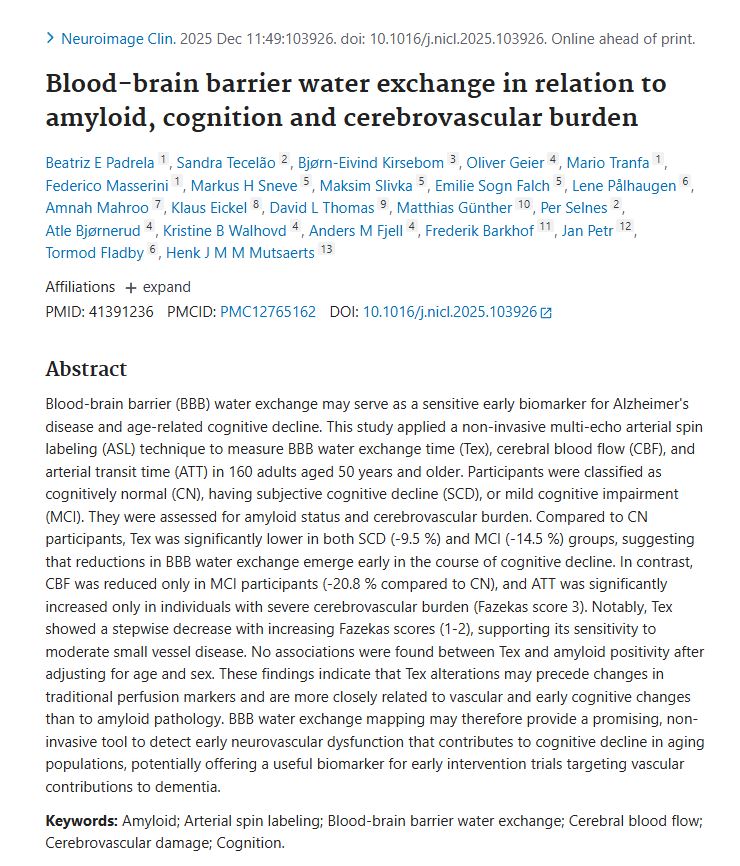
Understanding the earliest changes in the aging brain is essential for developing effective interventions against Alzheimer’s disease and vascular cognitive impairment. A newly published study featuring contributions from Prof. Matthias Günther and an international team of researchers sheds light on a promising biomarker: blood–brain barrier (BBB) water exchange.
Using a non‑invasive multi‑echo arterial spin labeling (ASL) technique, the study examined 160 adults aged 50+ across different cognitive stages. The findings reveal:
Key Highlights:
– Individuals with subjective cognitive decline (SCD) and mild cognitive impairment (MCI) showed significantly reduced BBB water exchange time (Tex) compared to cognitively normal participants.
– Tex decreases appeared earlier than changes in traditional perfusion markers such as cerebral blood flow.
– BBB water exchange showed a stepwise decline with increasing cerebrovascular burden, indicating strong sensitivity to small vessel disease.
– After adjusting for age and sex, no association was found between Tex and amyloid positivity.
– These results suggest that vascular and neurovascular changes may precede amyloid‑related pathology in the trajectory of cognitive decline.
Why This Matters
BBB water exchange mapping could become a powerful, non‑invasive tool for detecting early neurovascular dysfunction—long before more overt symptoms or structural changes appear. This opens new possibilities for early diagnosis, risk stratification, and targeted intervention trials focusing on vascular contributions to dementia.
If you are interested in evaluating ASL or exploring how advanced perfusion imaging can support your research or clinical studies, feel free to reach out to us — we’re happy to discuss how we can support your work.
Read the full publication HERE